
TikTok ads for creative brands are producing results in 2026 that Meta is struggling to match — and it’s worth understanding exactly why before you decide where to put your ad budget.
Meta isn’t dead. Let’s get that out of the way. Instagram and Facebook still have sophisticated audience targeting, and for brands with a proven offer and a tight customer avatar, Meta can still deliver. This isn’t a takedown. But for creative, DTC, and lifestyle brands trying to grow right now, the performance gap between TikTok and Meta is real — and it comes down to how the platforms work, not just which one is newer.
Here’s an honest breakdown.
Where Meta Still Holds Ground
Meta’s core strength is targeting precision. Its pixel has years of purchase data on hundreds of millions of users. If you have a tight custom audience — a solid email list, a strong lookalike pool, proven retargeting segments — Meta can put your ad in front of people with a high probability of converting.
It’s also a more predictable platform for scaling. Once you find a winning creative and a converting audience, Meta’s structure makes it relatively systematic to scale spend and forecast return.
The challenge is that Meta’s costs have climbed steadily. CPMs are up. Competition for the same audiences is high. And creative fatigue happens fast — you need to refresh ads frequently to stay effective. For smaller DTC brands without deep creative pipelines, that’s a real operational pressure.
According to Marketing Charts, Meta CPMs have increased year-over-year for the fourth consecutive year, putting pressure on smaller brands trying to compete with well-funded advertisers in the same audience pools.
Why TikTok Ads for Creative Brands Hit Differently
TikTok’s discovery model is fundamentally different from Meta’s. On Meta, you define who sees your ad. On TikTok, the algorithm decides — and it’s exceptionally good at finding the right audience.
TikTok distributes content based on engagement signals, not just audience demographics. A video from a brand with zero followers can reach a hundred thousand people if the content is compelling. The platform’s job is to surface content that makes people stay — and it does that at scale regardless of follower count or budget size.
This is why TikTok ads for creative brands work so well. You’re not fighting for a slice of an already-contested audience pool. You’re competing on the quality and resonance of your content. Win that bet, and the algorithm handles the distribution.
💡 The practical result: Cost per acquisition on TikTok is still lower than Meta for many creative categories — particularly fashion, beauty, food, music, home goods, and lifestyle. That gap has narrowed as TikTok’s ad business matured, but it’s still real, especially in niches where content naturally fits how TikTok users consume video.
TikTok for Business data shows that TikTok users are 1.5x more likely to immediately purchase something they discovered on the platform compared to other platforms. For DTC brands, that intent-to-purchase signal is hard to ignore.
What’s Actually Converting on TikTok Ads for Creative Brands (and What Isn’t)
The brands seeing real results share a few things in common.
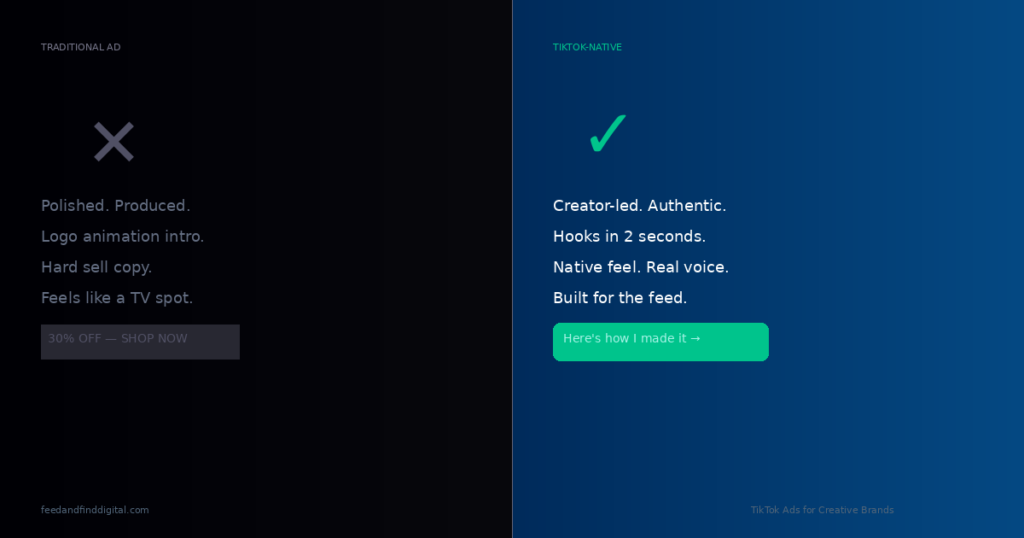
They shoot like TikTok creators, not like ad agencies. UGC-style content — someone holding your product, talking to the camera, showing the before and after — outperforms produced spots by a wide margin. Founder-led content, where the person who built the brand is on camera explaining why they made it, tends to perform especially well. It’s direct. It has a point of view. It feels like a real person talking, not a brand speaking.
They get to the point in the first two seconds. The first two seconds of any TikTok ad decide whether someone keeps watching. Brands that lead with a hook — a result, a surprising claim, a visual that makes someone stop scrolling — consistently outperform brands that ease into their message.
They make content that fits the feed. Vertical video, native text overlays, on-screen captions, trending audio used thoughtfully — TikTok users know when they’re watching something shot for a different platform and repurposed. It doesn’t convert.
What’s not working:
- Highly produced ads that look like TV commercials
- Brand films with sweeping music and beautiful cinematography
- Anything that opens with a logo animation
- Hard-sell copy (“30% off, shop now”) without entertainment or education value
These aren’t just neutral — they actively signal “ad” to TikTok users, who skip instantly. Social Media Today’s 2026 TikTok research confirms that native-style creative consistently outperforms repurposed content from other channels by a significant margin in both view-through and conversion rates.
The Creative Brands Winning Right Now
The through-line among brands actually winning with TikTok ads for creative brands isn’t budget. It’s creative philosophy.
They’ve stopped trying to make TikTok look like their other channels. They treat the platform as its own thing — with its own pacing, its own humor, its own relationship between brands and audiences. They experiment. They shoot content that’s designed to feel like it belongs there. They measure what actually converts, not what looks impressive in a presentation.
The brands losing on TikTok are the ones who take their Meta creative, resize it to vertical, and call it a TikTok strategy. The format may be the same. The performance isn’t.
If you want to know whether TikTok ads for creative brands make sense for your specific situation — including what kind of creative you’d need and what realistic results look like — our services page walks through how we approach campaigns. And if you’re thinking about how paid social fits alongside organic discovery through AI search, it’s worth reading What Is GEO and Why It Matters More Than SEO Right Now.
Key Takeaways
- Meta still works well for brands with tight custom audiences, proven offers, and budgets to handle rising CPMs
- TikTok ads for creative brands benefit from an algorithm that rewards content quality over audience spend — a genuine advantage for smaller, creative-led businesses
- The creative format that converts on TikTok is native, authentic, and fast — UGC-style, founder-led, and built for the feed
- Repurposing Meta ads to TikTok almost never works; the platform needs content designed specifically for it
- Cost per acquisition on TikTok is still favorable in fashion, beauty, food, music, home goods, and lifestyle — but only when the creative is right
Frequently Asked Questions
Q: Should I run TikTok Ads and Meta Ads at the same time, or pick one? A: For most creative brands, a sequenced approach makes more sense than picking one. Start where your creative is strongest. If you already have UGC-style content or founder-led video, TikTok is usually the faster path to results. Once you have proof of concept and a winning offer, layering in Meta for retargeting and scaling is a natural next step. Running both simultaneously without the right creative for each tends to dilute results on both platforms.
Q: How much budget do I need to test TikTok ads for creative brands? A: You can run a real test with $1,500–$3,000 over four to six weeks. The key is committing to creative iteration — not just launching one video and waiting. The brands that see fast results on TikTok are the ones treating it as a creative experiment, testing multiple hooks and formats, and doubling down on what works. Budget without creative flexibility rarely produces useful data.
Q: I’m not on TikTok personally. Does that matter? A: Less than you’d think. Your brand doesn’t need a massive organic following to run effective TikTok ads. The Ads Manager is separate from organic content, and the algorithm distributes paid content based on engagement, not follower count. That said, spending a few hours in the feed before you start shooting gives you a feel for what’s resonating with your audience — and it’s time well spent.
If you’re curious whether TikTok Ads make sense for your brand, or if you want an honest read on whether your current approach is leaving results on the table, that’s a great conversation to have on a free discovery call. No pressure. Just a real look at what’s working.